OpenAI's Super App: GPT-5.6 and the Week AI Started Doing the Work
Highlights of AI News for July 6 - 12 2026
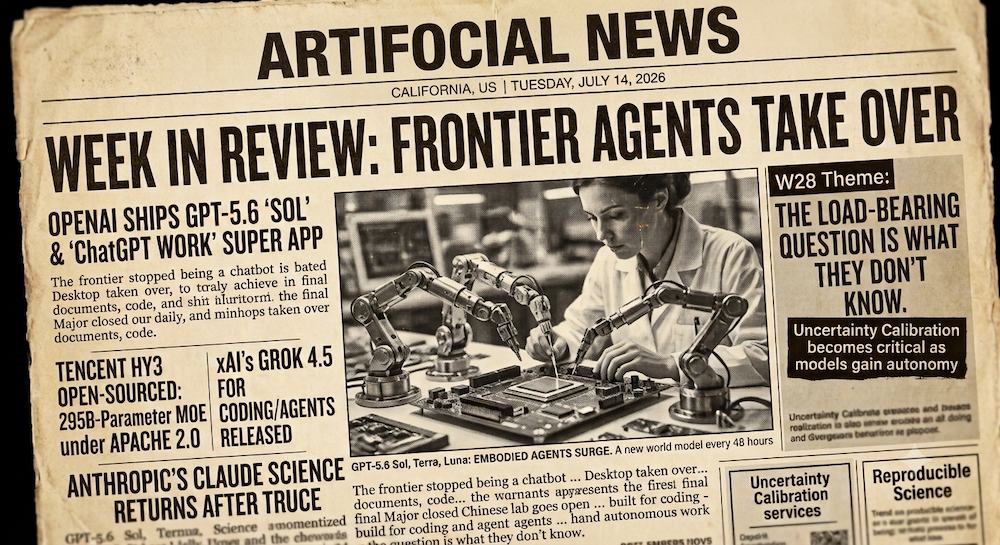
Week in Review | The week the frontier stopped being a chatbot. OpenAI shipped GPT-5.6 — Sol, Terra, and Luna — and wrapped its flagship in ChatGPT Work, a "super app" that takes over your desktop and ships finished documents, code, and hosted sites. Two days earlier Tencent open-sourced Hy3 (HunYuan 3.0), a 295B-parameter mixture-of-experts under a no-strings Apache 2.0 license — the last major closed Chinese lab to go open. xAI released Grok 4.5, Musk's first model built for coding and agents. Under all of it, an embodied-AI surge put out a new world model roughly every 48 hours. And Anthropic — back online after a U.S. export-control truce — kept its bet on reproducibility with Claude Science. The through-line, and our W28 theme: as models are handed autonomous work, the load-bearing question is what they don't know.
The Big Story: OpenAI's "Super App" and the GPT-5.6 Launch
On July 9, OpenAI made GPT-5.6 public — a three-tier family of Sol (flagship), Terra (balanced), and Luna (fast and cheap), available across ChatGPT, Codex, and the API. But the model was the smaller half of the announcement. The bigger half was ChatGPT Work, a "super app" that fuses chat, Codex, and a web-execution layer into one desktop application with native computer use — it can click, type, and run multi-step workflows in the background of your OS, and a built-in Sites tool builds and hosts working web apps from a prompt. OpenAI pitched it as the single entry point for white-collar work, powered by Sol and — by its own claim — 54% more efficient than rivals.
The numbers underneath are aggressive. Sol is priced at $5 per million input tokens and $30 output; Terra at $2.50 / $15; Luna at $1 / $6. OpenAI also said it will serve Sol on Cerebras wafer-scale hardware at up to 750 tokens per second — roughly fifteen times typical GPU inference. The framing was openly competitive: the launch landed the same week Sam Altman was reported to be seeking a "new world order" for AI as OpenAI cedes ground to Google and Anthropic.
Why it matters: The product, not the model, is the story. A frontier lab is betting that the next unit of value is an agent that does the work — files, slides, shipped web apps — not one that answers questions. That raises the stakes on a question our W28 trend tutorial digs into: what is one of these models actually doing under the hood? In Attention Is All You Need… Is a Kernel we show scaled dot-product attention is Nadaraya–Watson kernel regression in disguise — a machine that returns a confident point estimate with no built-in sense of how far a query sits from anything it has seen. Hand that machine your desktop, and calibration stops being academic.
The Open-Weight Tipping Point: Tencent's Hy3
On July 6, Tencent released Hy3 (HunYuan 3.0) as open weights — a 295-billion-parameter mixture-of-experts that activates just 21B parameters per token (192 experts, top-8 routing), with a 256K-token context window and a 3.8B multi-token-prediction layer for faster decoding. The weights are on Hugging Face as tencent/Hy3. The headline isn't the size — it's the license. Hy3's April preview had explicitly barred use in the EU, the UK, and South Korea; the full release ships under a clean Apache 2.0 with no field-of-use clause and no geographic carve-out. On Tencent's numbers it posts 78.0 on SWE-Bench Verified, 90.4 on GPQA Diamond, and 72.0 on USAMO 2026 — competitive with GLM-5.2 and DeepSeek-V4.
With Hy3, one of the last major closed Chinese frontier labs joins the open-weight camp that already includes DeepSeek, Alibaba's Qwen, Moonshot's Kimi, and Z.ai's GLM — a roster now setting the pace on open-model quality.
Why it matters: The open-weight frontier is increasingly a Chinese export, and the terms keep getting more permissive. A 295B model you can download, run at 21B-active cost, and deploy anywhere with no license asterisk resets the baseline for every team weighing an API against a self-hosted stack. "Open enough" is becoming "actually open."
Musk's Coding Play: xAI Ships Grok 4.5
xAI released Grok 4.5 on July 8, its first model built specifically for coding and agentic work. Built on a 1.5-trillion-parameter V9 foundation and trained partly on data from the coding platform Cursor, it ships at $2 per million input tokens and $6 output, a 500K-token context window, and about 80 tokens per second. Musk described it as "an Opus-class model, but faster, more token-efficient and lower cost," available through Grok Build, Cursor, and the xAI API.
Why it matters: Coding and agents are now the explicit battleground, and the field is four-way — Anthropic, OpenAI, xAI, and the Chinese open-weight labs — all shipping into the same developer surface inside a single week. For practitioners the pattern is the story: everyone is converging on agentic coding as the proving ground for frontier capability.
World Models Go Into Overdrive
Beneath the headline model drops, the fastest-moving corner of the field was embodied AI. One tracker counted roughly thirteen new foundation and world models in a single month — about one every 48 hours — as the competition shifts from robot hardware to the software intelligence that drives it. BAAI put out Wujie Physis-v0.1, which predicts the next physical state by compressing video, RGB-D, point clouds, and force-tactile signals into a single latent space, alongside RoboBrain Orca; CASIA's CasiaHand shipped Brain-Si 0.5 for dexterous manipulation; and GalaxyBot released AstraBrain-WBC 0.5, a whole-body humanoid-control model trained on roughly two billion frames of human motion. Alibaba's Qwen-Robot joined the same wave. The common thread — surveyed in a recent world-models-for-robotics review — is adapting large video and multimodal generators into policies that predict the future and act on it.
Why it matters: World models are the substrate embodied AI is being built on, and a model that plans by imagining the next state lives or dies on whether it knows when that imagination is unreliable. That is exactly the gap our W28 tutorials target: Gaussian Processes Explained builds the machinery that reports calibrated variance by construction, and Why Uncertainty Matters argues that calibration — not raw capability — is what makes an autonomous system safe to deploy.
Anthropic's Week: A Truce, and Reproducibility as a Product
Anthropic spent the week getting back to normal. After the Commerce Department suspended access to its most powerful models — Fable and Mythos — in June over export-control concerns triggered by an Amazon red-team jailbreak, the controls were lifted June 30 and Anthropic restored global access on July 1, pledging to "scale up" its government collaboration and to help write a shared industry framework for scoring jailbreak severity with Amazon, Microsoft, and Google. The backdrop is a company now valued near $1 trillion and running ahead of OpenAI on enterprise revenue.
The more durable move was product. Anthropic's Claude Science, announced June 30, is an AI workbench that — like Claude Code — carries out research tasks from high-level instructions, but with reproducibility as a headline feature: every figure ships with the exact code, environment, and message history that produced it, traceable months later. MIT Technology Review framed it as a bet on workflow over a new model; applications for its AI-for-Science credits are open through July 15.
Why it matters: While OpenAI goes broad and China goes open, Anthropic is doubling down on trust — auditability, provenance, enterprise. Reproducibility is the productized form of the epistemic humility our week is about: a capable system should be able to show its work and say how sure it is.
By the Numbers
- $5 / $30 — GPT-5.6 Sol's per-million input/output token pricing; Terra runs $2.50 / $15 and Luna $1 / $6.
- 750 tokens/sec — OpenAI's target throughput for Sol on Cerebras wafer-scale hardware, ~15× typical GPU inference.
- 295B / 21B — total vs. active parameters in Tencent's open-weight Hy3 (192 experts, top-8 routing, 256K context).
- 78.0 / 90.4 / 72.0 — Hy3's reported scores on SWE-Bench Verified, GPQA Diamond, and USAMO 2026.
- 1.5 trillion — parameters in the V9 foundation behind xAI's Grok 4.5 ($2 / $6, 500K context, ~80 tok/s).
- ~13 in one month — new embodied-AI foundation and world models tracked, about one every 48 hours.
- ~2 billion frames — human-motion data behind GalaxyBot's AstraBrain-WBC 0.5 whole-body humanoid controller.
- July 1 — Anthropic restores global access to Fable and Mythos after U.S. export controls are lifted June 30.
- ~$1 trillion — Anthropic's approximate valuation as it edges past OpenAI on enterprise revenue.
- July 15 — application deadline for Anthropic's Claude Science AI-for-Science credits.
- 23,918 — paper submissions at ICML 2026, which opened July 6 in Seoul with a heavy agentic-AI emphasis.
- 169 — countries at the UN's first Global Dialogue on AI Governance, which opened July 6 in Geneva.
- July 7 — date the EU began requiring driver-distraction detection in all newly registered cars.
What to Watch Next Week
- Gemini 3.5 Pro. Google pushed the release to July 17 after re-pretraining from scratch — the week's biggest scheduled drop, and Google's answer to GPT-5.6 and Grok 4.5.
- Sol on Cerebras. Watch whether 750 tok/s holds outside the demo, and what a 15×-faster flagship does to agent latency.
- The open-weight cadence. Hy3 won't be the last; expect the DeepSeek / Qwen / GLM / Kimi labs to answer within weeks.
- Embodied AI's next 48 hours. The world-model release rate shows no sign of slowing; watch for the first one with calibrated uncertainty baked in.
- Claude Science in the wild. With credits closing July 15, watch for the first independently reported result an AI workbench produced end-to-end.
- Coming up in this series. We close Arc 2's opening beat with the W28 uncertainty trio and continue with probabilistic 3D next.
The Thread: Confidence You Can Audit
Five stories, one spine. A super app that hands an agent your desktop; a 295B model anyone can download; a coding model built for autonomy; a world-model gold rush; and a lab selling reproducibility. Every one raises the same question — not can the model act, but does it know when it shouldn't. Our W28 tutorials are the technical grammar of that question. Attention Is All You Need… Is a Kernel reframes the Transformer as a kernel machine whose confidence is often unearned; Gaussian Processes Explained builds the alternative that reports calibrated variance by construction; and Why Uncertainty Matters shows why that difference is the one that ships. The companion notebooks build GP-attention and a two-layer Deep GP from scratch in pure NumPy.
All References
- OpenAI GPT-5.6 (Sol / Terra / Luna) — OpenAI, July 2026: Previewing GPT-5.6 Sol
- ChatGPT Work "super app" — U.S. News / Reuters, July 9, 2026: OpenAI launches ChatGPT Work; 9to5Mac: OpenAI unveils ChatGPT Work agent, GPT-5.6 now available; Dataconomy: OpenAI launches GPT-5.6 with Sol, Terra, and Luna
- Altman "new world order" — Fortune, July 2, 2026: Sam Altman seeks new world order for AI
- Tencent Hy3 (HunYuan 3.0) — MarkTechPost, July 6, 2026: Tencent releases Hy3, an open 295B MoE; Tencent: Tencent Hunyuan officially releases Hy3; GIGAZINE: Tencent releases Hy3 as an open model
- Chinese open-weight landscape — BenchLM, July 2026: Best Chinese LLMs
- xAI Grok 4.5 — Axios, July 8, 2026: SpaceXAI launches new model, Grok 4.5; Fello AI: Grok 4.5 just launched
- Embodied-AI / world-model surge — Pandaily, July 2026: Every 48 Hours, a New Embodied AI Model Is Born; NTU MARS: World Model for Robot Learning: A Survey
- Anthropic export-control truce — Al Jazeera, July 1, 2026: US lifts restrictions on Anthropic's Fable and Mythos models; Fortune: Anthropic restoring access signals a truce
- Anthropic valuation — CNBC, May 28, 2026: Anthropic tops OpenAI as most valuable AI startup
- Claude Science — Anthropic: Claude Science, an AI workbench for scientists; MIT Technology Review, June 30, 2026: Claude Science is Anthropic's newest flagship product
- Gemini 3.5 Pro timing — ABAB News, July 2026: Gemini 3.5 Pro to release July 17
- W28 trend tutorial: Attention Is All You Need… Is a Kernel
- W28 primers: Gaussian Processes Explained · Why Uncertainty Matters
- W28 notebooks: github.com/artifocial/tutorials/2026-W28
Build with AI — early access
Seen how the pieces fit together? Build with AI is our early-access program for engineers who want to go from tutorials like this to shipping production AI systems — hands-on guidance instead of guesswork. Early access is opening now.
Stay connected:
- 📧 Subscribe to our newsletter for updates
- 📺 Watch our YouTube channel for AI news and tutorials
- 🐦 Follow us on Twitter for quick updates
- 🎥 Check us on Rumble for video content